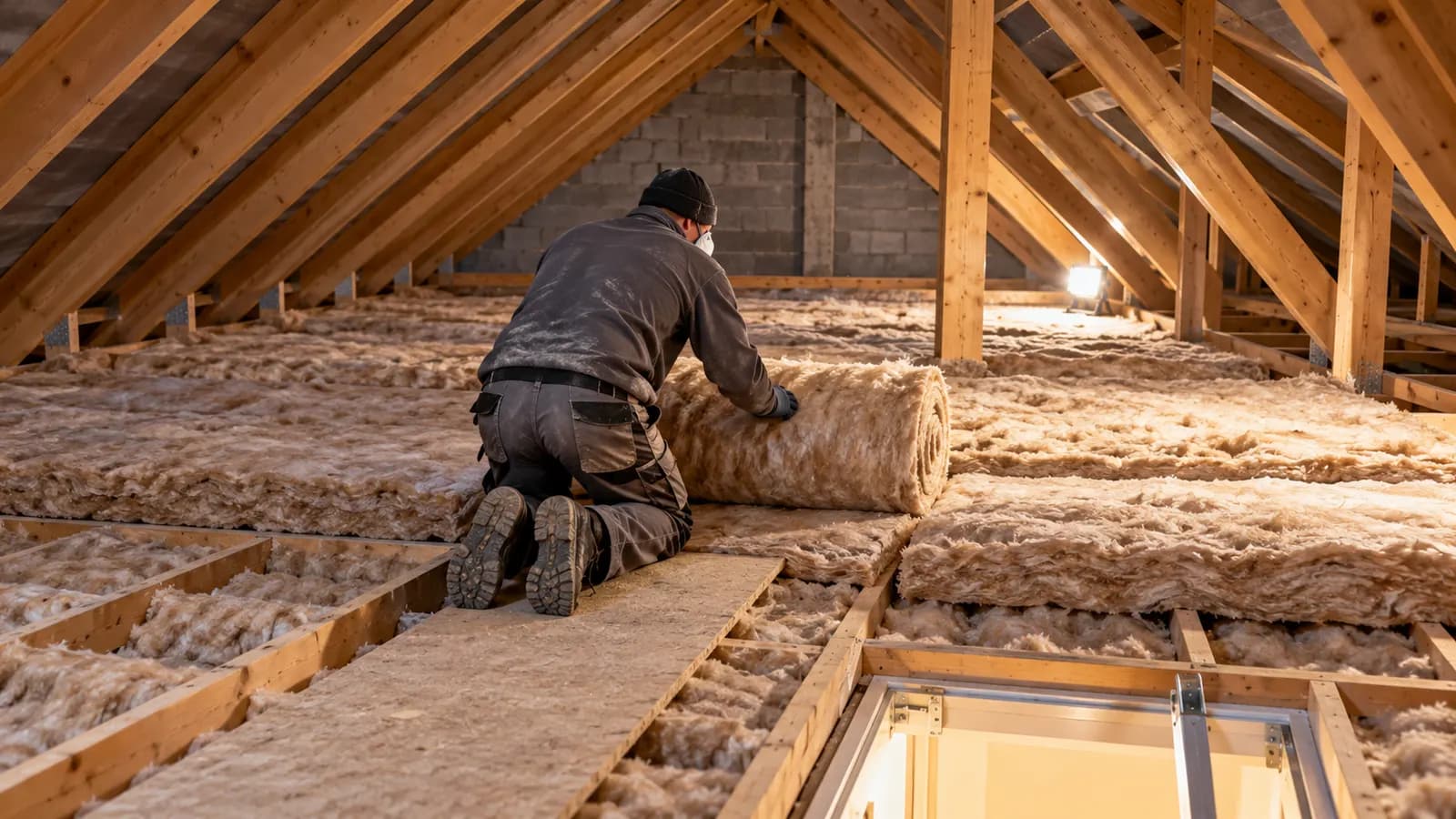
Attic Insulation in Dublin by SEAI-Registered Installers
Professional attic insulation by Dublin's leading experts. Save up to 30% on energy bills and access generous SEAI grants today.
Why Choose Attic Insulation?
Did you know that up to 30% of your home's heat can escape through an uninsulated roof? It's like leaving a window wide open all winter. In Dublin's damp climate, proper insulation isn't just about warmth—it's about protecting your home's structural integrity.
Our premium mineral wool and spray foam solutions create a high-performance thermal envelope, trapping heat where it belongs: inside your living space.
- check_circleReduce Heat Loss (Up to 30%)
- check_circleLower Energy Bills Permanently
- check_circleQuick & Clean Installation
- check_circleSEAI Grants Available

Attic Insulation for Dublin Homes
Most Dublin homes lose a significant amount of heat through the roof. Whether you live in a period terrace in the city centre or a modern semi-detached in Swords or Bray, attic insulation is typically the single most cost-effective energy upgrade you can make. It's also known as loft insulation or ceiling insulation — different names for the same job of laying insulation across your attic floor.
For the best results, we recommend combining attic insulation with cavity wall insulation or external wall insulation. A whole-house approach can cut your heating bills by 40-60%.
How Much Attic Insulation Do You Need?
The usual target for an Irish attic is around 300mm of mineral wool laid in two layers: one between the ceiling joists and a second layer across them. That brings a typical loft close to the 0.16 W/m²K U-value set for roofs insulated at ceiling level in the Building Regulations (Technical Guidance Document L). Many older Dublin homes have only 50-100mm, often settled or patchy, which is why a top-up makes such a difference. We measure what's already there during your free home insulation survey before recommending anything.
Attic Insulation Types Compared
| Type | Best for | Notes |
|---|---|---|
| Mineral wool rolls | Standard, unconverted lofts | The most common and cost-effective option, laid across the attic floor. |
| Blown (loose-fill) insulation | Awkward joists or low, hard-to-reach lofts | Blown in to fill gaps evenly where rolls are difficult to lay. |
| Spray foam | Rafters, irregular roof shapes, airtightness | Applied to the underside of the roof, not the attic floor. Needs a certified system and a ventilation check. |
| Rigid insulation boards | Converted attics and rooms in the roof | Fitted between and under the rafters as part of roof insulation or a warm roof. |
Attic Foam Insulation in Dublin
Attic foam insulation means spraying foam onto the underside of the roof between the rafters, instead of laying insulation on the attic floor. It suits converted attics and irregular roof spaces where rolls can't be laid, and it creates an airtight layer. It isn't the right answer for every home: the roof timbers still need to be able to breathe, so we only recommend a certified spray foam system after checking ventilation and the condition of the roof. For a standard loft, mineral wool on the attic floor is usually cheaper and just as effective.
Attic Insulation Grants
SEAI pays a fixed attic insulation grant based on your home type (see the table below), with higher amounts for first-time buyers and homeowners on qualifying welfare payments. Your home must have been built and occupied before 2011, and you need SEAI grant approval before the work starts. See our SEAI insulation grants guide for eligibility and how to apply, and our attic insulation cost guide for what affects the price.
Choosing an Attic Insulation Company in Dublin
When comparing attic insulation companies, installers or contractors near you, check three things: SEAI registration (you need a registered contractor to claim the grant), a proper pre-work survey rather than a quote over the phone, and an itemised quote that shows exactly what's being installed and which SEAI grant applies. We do all three as standard.
Our installers work locally across every part of Dublin, from Finglas and Glasnevin on the northside to Rathfarnham, Tallaght and Sandyford on the southside — see the full list of areas we cover.
Outside Dublin, we provide attic insulation in Drogheda, as well as Navan and Mullingar. Get a free quote today.
Our 4-Step Installation Process
Professional, transparent, and hassle-free from start to finish.
Free Home Survey
We assess your current insulation levels and identify heat loss areas.
Tailored Quote
Receive a detailed breakdown of costs, material options, and the SEAI grant your home qualifies for.
Expert Installation
Our SEAI-registered team installs your insulation quickly, with minimal disruption.
Post-Install Check
A final quality audit ensures optimal coverage and efficiency.
SEAI Attic Insulation Grants (2026)
| Home Type | Standard SEAI Grant | First-Time Buyers & Qualifying Welfare |
|---|---|---|
| Apartment (top floor) | €1,100 | €1,400 |
| Mid-terrace | €1,400 | €1,800 |
| Semi-detached / end of terrace | €1,500 | €1,900 |
| Detached | €2,000 | €2,500 |
Fixed grant amounts published by SEAI for the Better Energy Homes attic insulation grant. Homes must be built and occupied before 2011. Your exact price is confirmed at survey.
Check Your EligibilityAttic Insulation FAQs
How long does attic insulation last?expand_more
High-quality mineral wool and fiberglass insulation can last 80 to 100 years. However, we recommend a check-up every 15-20 years to ensure settling hasn't reduced its thermal efficiency.
What is the best material for my attic?expand_more
It depends on your attic's usage. For standard lofts, roll-out mineral wool is cost-effective. For complex shapes or drafty areas, spray foam provides a superior airtight seal.
Can I still use my attic for storage?expand_more
Yes! We can install "raised flooring" or attic stilts that sit above the insulation layers, allowing you to store items without compressing the materials.
How much can I save on bills?expand_more
The average Dublin household saves between 20% and 30% on their annual heating costs. Most homeowners see the installation pay for itself through energy savings within 3-5 years.
How do I apply for the SEAI attic insulation grant?expand_more
You apply online with SEAI and must have grant approval before work starts. After the insulation is installed, a post-works BER is carried out, you submit the completion documents, and SEAI pays the grant to you. We give you the quote and contractor details you need and help you through each step.
How much is the SEAI attic insulation grant?expand_more
It's a fixed amount by home type: €1,100 for a top-floor apartment, €1,400 for a mid-terrace, €1,500 for a semi-detached or end-of-terrace house and €2,000 for a detached house. First-time buyers and homeowners on qualifying welfare payments can get up to €2,500.
Is attic foam insulation a good idea?expand_more
It can be for converted attics and irregular roof spaces, where foam is sprayed between the rafters. For a standard loft, mineral wool on the attic floor is usually cheaper and just as effective. We only recommend spray foam after checking ventilation and the condition of your roof.
Is loft insulation the same as attic insulation?expand_more
Yes — "loft insulation," "attic insulation," and "ceiling insulation" all refer to the same job: laying insulation across the floor of your attic space to stop heat rising out through the roof.
How do I choose an attic insulation company near me?expand_more
Look for SEAI registration (you need a registered contractor to claim the grant), a proper in-person survey before quoting, and an itemised quote showing what's being installed and which grant applies. We meet all three as standard.
What's the difference between attic insulation and roof insulation?expand_more
Attic insulation is laid across the floor of your loft. Roof insulation is installed between or under the rafters instead, which suits converted attics or rooms-in-roof. See our full comparison on the roof insulation page.
Ready to Get Started?
Book Your Free SurveyOur Other Services
Roof Insulation
Targeted insulation solutions directly under the roof membrane.
Spray Foam Insulation
Advanced airtight sealing for irregular spaces and hard-to-reach areas.
Cavity Wall Insulation
Reducing heat loss through your external walls for whole-home comfort.