Warm Roof Insulation in Dublin for Flat & Pitched Roofs
Professional warm roof insulation by Dublin's leading experts. Save up to 30% on energy bills and access generous SEAI grants today.
Why Choose Warm Roof Insulation?
A "warm roof" places insulation above or at rafter/deck level, so the whole roof structure stays warm and dry — as opposed to a "cold roof," where insulation sits at ceiling or joist level and the roof void above stays cold and ventilated.
Warm roof construction is the standard recommended approach for flat roofs, and the right choice for pitched roofs with converted attics, vaulted ceilings, or rooms-in-roof where you can't insulate at ceiling level.
- check_circleNo Loss of Attic Storage Space
- check_circleLower Condensation Risk
- check_circleSuits Flat & Pitched Roofs
- check_circleRafter Work Can Qualify for SEAI Grant

Warm Roof vs Cold Roof: What's the Difference?
In a cold roof, insulation is laid at ceiling level (the loft floor) and the roof space above stays cold and ventilated — this is standard attic insulation. In a warm roof, insulation is placed above the ceiling line, either between and over the rafters or on top of the roof deck, so the roof structure itself stays warm. Both are legitimate approaches; which one suits your home depends on how the roof space is used.
Warm Roof Insulation for Pitched Roofs
For converted attics, vaulted ceilings, and rooms-in-roof, a warm roof is usually the only option, since there's no accessible ceiling line to insulate at loft-floor level instead. This is exactly what our rafter-level roof insulation service delivers, often paired with spray foam insulation for a fully airtight seal around awkward junctions.
Flat Roof Warm Insulation in Dublin
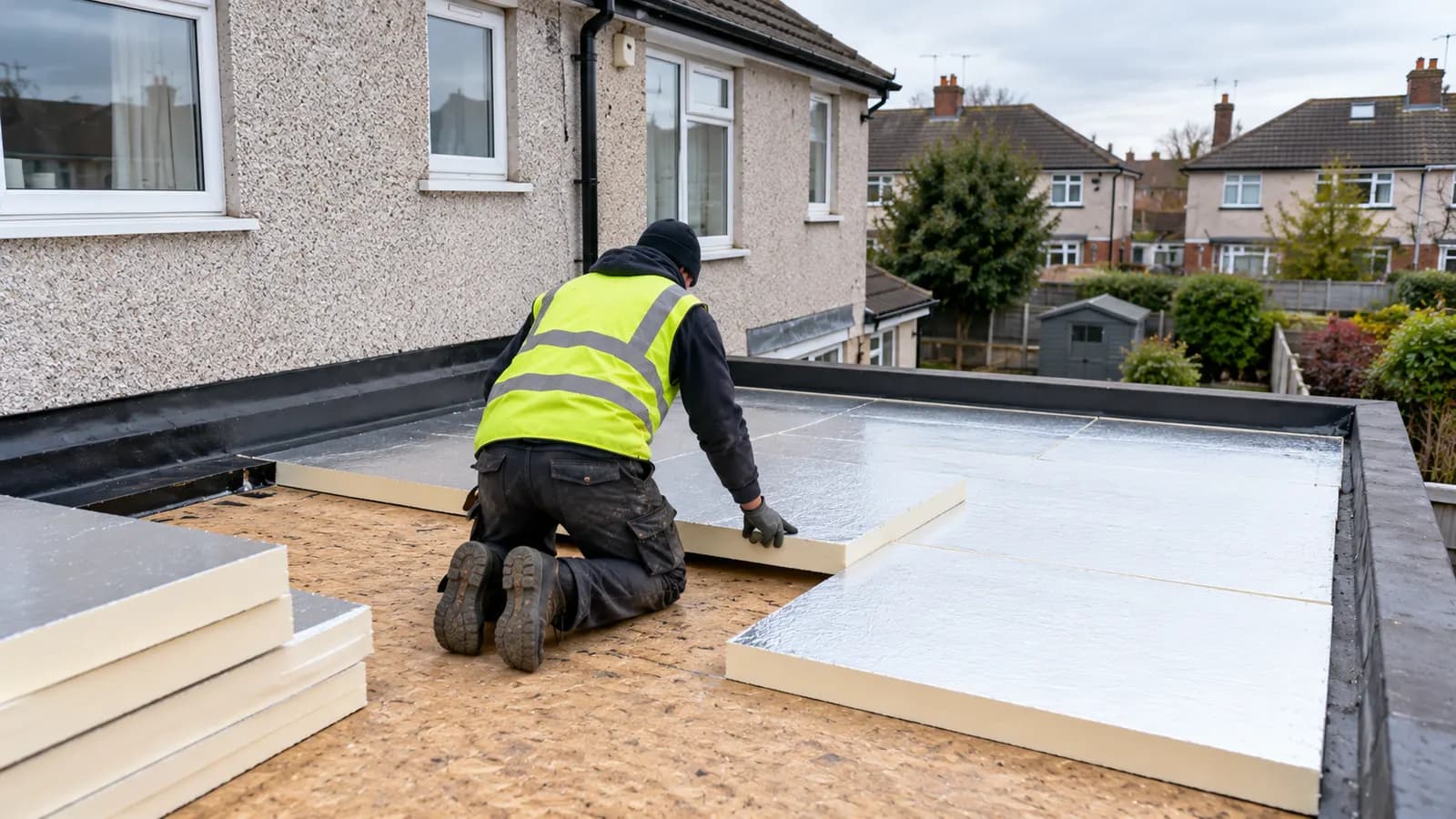
For flat roofs, a warm roof is the recommended construction method: insulation sits above the roof deck, directly beneath the waterproof membrane, keeping the deck itself warm and significantly reducing the condensation risk that a cold flat-roof build (insulation below the deck, ventilated void above) can carry over time.
Across Dublin, the flat roofs we see most are on rear kitchen extensions, garages, dormers and 1960s-70s porches, many with little or no insulation under an ageing felt covering. The best time to upgrade to a warm flat roof is when the covering is due for replacement anyway: rigid insulation boards go down over the existing deck, followed by a new waterproof membrane, so the room below doesn't lose any ceiling height.
Cost & SEAI Grants
Rafter-level warm roof insulation on a pitched roof can qualify under SEAI's attic and rafter insulation grant, which is a fixed amount by home type. Flat roof insulation isn't listed as a separate SEAI individual grant, so we'll confirm what applies to your home at survey. See our SEAI grant amounts and eligibility guide for the full breakdown, or our insulation cost guide for what affects the price. Exact cost depends on roof size, pitch, and current construction.
We install warm roof insulation across Dublin and beyond, including Swords, Bray, and Drogheda. Request a free survey to find out which approach suits your roof.
Our 4-Step Installation Process
Professional, transparent, and hassle-free from start to finish.
Free Home Survey
We assess your current insulation levels and identify heat loss areas.
Tailored Quote
Receive a detailed breakdown of costs, material options, and the SEAI grant your home qualifies for.
Expert Installation
Our SEAI-registered team installs your insulation quickly, with minimal disruption.
Post-Install Check
A final quality audit ensures optimal coverage and efficiency.
Warm Roof Insulation FAQs
What is a warm roof?expand_more
A warm roof places insulation above or at rafter/deck level, so the roof structure itself stays warm — as opposed to a cold roof, where insulation sits at ceiling level and the roof void above stays cold.
Is a warm roof better than a cold roof?expand_more
Neither is universally "better" — it depends on how the space is used. A cold roof (standard attic insulation) is usually cheaper and simpler for an unconverted loft. A warm roof is generally necessary for converted attics, vaulted ceilings, and is the recommended approach for flat roofs.
Can a flat roof be insulated as a warm roof?expand_more
Yes — a warm roof is the standard recommended construction for flat roofs, with insulation placed above the deck beneath the waterproof membrane, which also reduces condensation risk compared to a cold flat-roof build.
Is warm roof insulation eligible for an SEAI grant?expand_more
Rafter-level warm roof insulation on a pitched roof can qualify under SEAI's attic and rafter insulation grant. Flat roof insulation isn't listed as a separate SEAI individual grant, so we confirm what applies to your home during a free survey.
When should I insulate my flat roof?expand_more
The best time is when the roof covering is due for replacement. Insulation boards go on top of the existing deck under a new waterproof membrane, so you don't lose ceiling height in the room below.
How much does warm roof insulation cost?expand_more
Cost depends on your roof's size, pitch, and current construction. See our insulation cost guide for typical pricing, or book a free survey for an exact price.
Ready to Get Started?
Book Your Free SurveyOur Other Services
Roof Insulation
Rafter-level insulation solutions for converted attics or vaulted ceilings.
Spray Foam Insulation
Airtight sealing for irregular spaces and hard-to-reach areas.
Insulation Cost Guide
Typical prices and SEAI grant amounts across every insulation type.